

It is the 28th, and the finance manager has two lists open. One shows AED 450,000 that customers owe the company, some of it for months. The other shows AED 300,000 the company owes its suppliers, and the biggest supplier phoned this morning. Cash is tight, yet the bank balance only makes sense if somebody knows which cheques are post-dated and which invoices are really collectable. That tension, between money coming in and money going out, is the whole story of accounts receivable and payable.
This guide explains both sides in plain language: how to invoice, chase and collect, how to receive bills and pay suppliers on time, which numbers show if you are in control (with worked examples you can check by hand), and a month-end routine you can copy. Where Nashora helps, we say exactly how, and where it does not, we say that too.
Accounts receivable and payable in plain words
Accounts receivable (AR) is the money customers owe you for goods or services you have already delivered. Accounts payable (AP) is the money you owe suppliers for goods or services you have already received. Both start life as a document: a sales invoice on one side, a vendor bill on the other.
Why do they deserve a whole discipline? Because they decide your cash. A company can be profitable on paper and still miss payroll if customers pay in 75 days while suppliers want payment in 30. A company can also hurt itself the other way, paying every bill the day it arrives and starving its own working capital.
The aim is not to collect as fast as possible and pay as slowly as possible. That wrecks relationships on both sides. The aim is to know, every week, what is due in and what is due out, and to make those two lists agree with the bank and the ledger.
Accounts receivable: from invoice to cash
Most late payments start before the invoice is even sent. A delivery with no signed delivery note, a price different from the quotation, a missing purchase order number: each one gives the customer a polite reason to wait. Fix the front of the process and the back gets easier.
Invoice promptly and accurately
Invoice on delivery, not at the end of the month. A tax invoice must carry the details the FTA requires, including your TRN, and the right VAT on each line. An invoice that is wrong comes back for correction, and the clock on payment effectively restarts.
Set credit terms, and write them down
Net 30 means payment is due 30 days after the invoice date. Decide the terms per customer type, put them on the quotation and the invoice, and agree a credit limit for each account in your own policy. New customers on cash or advance payment until they have a record are a perfectly respectable approach. A proforma invoice is useful for exactly that.
Statements and follow-ups
Customers rarely chase their own bills. A friendly reminder a few days before the due date, a firmer one on the due date and a call at 15 days overdue cover most cases. A statement showing every open invoice makes it hard to say "we never received it". Name one person to own each overdue account, and write down what the customer promised and when.
- Quote and confirm terms. The price, the delivery and the payment terms are all on the quotation.
- Deliver with proof. A signed delivery note ties the invoice to goods that arrived.
- Invoice the same day. Correct VAT, correct TRN, correct due date.
- Remind before the due date. A short message the week the invoice falls due.
- Record the receipt against the invoice. Cash, transfer or cheque, allocated to the invoice it pays.
- Escalate in steps. A call, then a manager, then a written notice, according to your policy.
Reading a receivables aging report
An aging report groups what customers owe by how late it is. It is the single most useful list in receivables, because it turns "we are owed AED 450,000" into "AED 90,000 of it is more than 90 days past due, and it belongs to two customers".
Buckets are usually current (not yet due), 1 to 30 days past due, 31 to 60, 61 to 90 and over 90. Here is an illustrative example with five customers. All figures are made up, in AED.
| Customer | Current | 1-30 | 31-60 | 61-90 | Over 90 | Total |
|---|---|---|---|---|---|---|
| Customer A | 60,000 | 20,000 | 0 | 0 | 0 | 80,000 |
| Customer B | 35,000 | 25,000 | 30,000 | 0 | 0 | 90,000 |
| Customer C | 0 | 10,000 | 15,000 | 45,000 | 0 | 70,000 |
| Customer D | 25,000 | 0 | 0 | 0 | 60,000 | 85,000 |
| Customer E | 45,000 | 30,000 | 20,000 | 0 | 30,000 | 125,000 |
| Total | 165,000 | 85,000 | 65,000 | 45,000 | 90,000 | 450,000 |
| Share of total | 36.7% | 18.9% | 14.4% | 10.0% | 20.0% | 100.0% |
Check it: the five customer totals (80,000, 90,000, 70,000, 85,000 and 125,000) add up to 450,000, and so do the five buckets (165,000, 85,000, 65,000, 45,000 and 90,000). The share row divides each bucket by 450,000, so 165,000 is 36.7% and 90,000 is 20.0%.
What would you do with this? Notice that 135,000, which is 30% of everything owed, is more than 60 days past due (45,000 plus 90,000). Customer D owes 60,000 in a single old bucket, which suggests one disputed or forgotten invoice rather than a habit of paying late. Customer C is drifting, with most of its balance in the 61 to 90 bucket, so call before it reaches 90. And Customer A is simply fine. The report does not tell you why; it tells you which five phone calls to make.
Post-dated cheques, receipts and allocations
In the UAE, cheques are still a daily fact of business life, and post-dated cheques (PDC) are a common way of agreeing payment terms. A customer hands over three cheques dated at 30, 60 and 90 days, and the invoices are, in effect, paid on a schedule. It is convenient, and it needs discipline.
Treat a PDC as a promise, not as cash
A post-dated cheque in your drawer is not money in the bank. Record it in a cheque register with its date, the customer and the invoice it covers, and look at that register weekly. Deposit it on the due date, then mark it cleared when the bank statement shows it. If it is returned, record that and reopen the invoice, because the debt is back.
Allocate every receipt
When a customer pays, the receipt should be allocated to the invoice or invoices it settles. Unallocated receipts, money "on account", make the aging report lie: the customer appears to owe old invoices in full while holding a credit nobody applied. Ask customers for a remittance advice, and when they pay a round figure against several invoices, allocate it to the oldest first unless they say otherwise.
Partial payments and short payments
Customers often pay a little less than the invoice, usually because of a disputed line or a bank charge. Do not leave a few dirhams hanging forever. Decide a small tolerance, resolve the real disputes quickly, and use a credit note when the customer was right.
Bad debts, credit notes and VAT
Some invoices will never be paid. The honest approach is to spot them early, keep records of every chase, and write them off in a controlled way, with an approval. Your accountant decides how to treat doubtful debts, including any provision, in the books. Do not let a 12-month-old invoice sit on the aging report as if it were worth its full face value.
A credit note is the formal way to reduce what a customer owes, for returned goods, a price correction or a settled dispute. VAT follows the credit note. Say you invoiced AED 10,000 plus AED 500 VAT, a total of AED 10,500, and later issue a credit note for AED 2,000 plus AED 100 VAT, a total of AED 2,100. The customer now owes AED 10,500 minus AED 2,100, which is AED 8,400. Your output VAT for the period falls by AED 100, and the customer's input VAT falls by the same amount.
Keep this at a general level and check the current rules. The requirements for tax credit notes, the period in which the VAT adjustment is made, and the conditions for VAT relief on bad debts (these depend on how long the debt has been overdue and whether it has been written off) are set by the FTA and can change. Ask your tax adviser before you rely on any of it. Our guide to how to calculate VAT in the UAE shows the invoice arithmetic.
Accounts payable: from bill to payment
Payables look easier than receivables because you control the cash, but the risk is different: paying the wrong amount, paying twice, or paying a bill nobody approved. A tidy payables process answers three questions for every bill. Did we order it? Did we receive it? Is the price right?
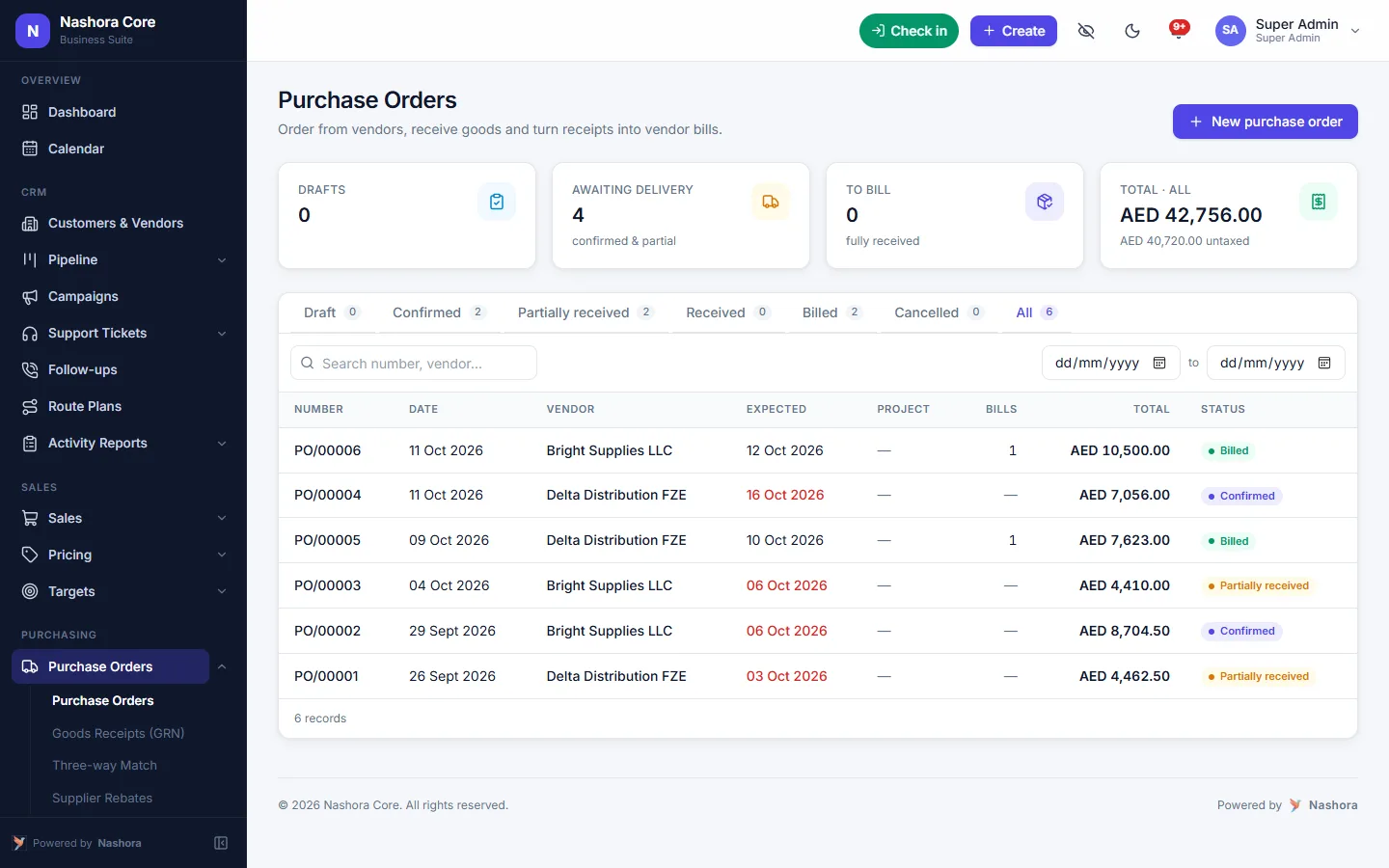
That is the idea of a three-way match: purchase order, goods received note and vendor bill agree before anything is paid. Nashora supports this match, and the screen below shows the purchase orders list, where each order moves from draft to confirmed, partially received, received and billed.
Bills, due dates and approvals
Enter every bill when it arrives, even if you do not plan to pay it for weeks. A bill that lives in someone's inbox is a liability you have not recorded, and it makes the month's costs and VAT look better than they are. Give each bill a due date from the supplier's terms, and route it for approval according to amount: a small utility bill needs one signature, a large equipment invoice needs two.
Plan the payment run
Pay on a rhythm, such as twice a week or every Thursday, rather than whenever a supplier phones. Before each run, look at the payable aging, sort by due date, and decide what to pay in full, what to pay in part and what to ask for more time on. Pay critical suppliers first, because stock you cannot get is worse than a late fee.
Paying by cheque or transfer
Pay by transfer or by cheque, but record it against the bill straight away. If you issue post-dated cheques to suppliers, they belong in the same register as the ones you receive, so you know on any day how much cash must be in the account for cheques falling due this week.
Early-payment discounts and supplier statements
Some suppliers offer a discount for paying early, often written "2/10, net 30": 2% off if paid within 10 days, otherwise the full amount in 30. Is it worth taking? Work it out.
Say a bill is AED 50,000. Taking the discount means paying AED 49,000 on day 10 instead of AED 50,000 on day 30. You save AED 1,000 by paying 20 days early. That is 1,000 divided by 49,000, about 2.04%, earned in 20 days. There are 365 divided by 20, or 18.25, such periods in a year, so the simple annualised return is about 2.04% times 18.25, roughly 37%. If your overdraft costs far less than that, take the discount. If cash is genuinely short, it may still be worth borrowing for.
Reconcile supplier statements
Once a month, ask your main suppliers for a statement and compare it with your ledger. Differences are normal; unexplained ones are not. Suppose your ledger shows AED 85,000 owed to a supplier and their statement says AED 92,500. You find one invoice for AED 10,500 that you have not yet booked, and one payment of AED 3,000 that you made and they have not yet recorded. Adding the invoice to your figure gives 95,500, and deducting the payment gives 92,500, which matches their statement. The AED 7,500 gap is explained, and you know exactly what to book and what to chase.
DSO, DPO and working capital: the numbers that matter
Three numbers tell you most of what you need. None needs a degree in finance, but each needs consistent definitions. Pick them and track them every month, the same way every time.
Days sales outstanding (DSO) is the average number of days it takes to collect. The formula is receivables divided by credit sales, multiplied by the days in the period. Say receivables at quarter end are AED 450,000 and credit sales for the 90-day quarter were AED 1,200,000. DSO is 450,000 divided by 1,200,000, which is 0.375, times 90, which is 33.75 days.
Days payable outstanding (DPO) is the average number of days you take to pay. Using payables divided by credit purchases, times days: payables of AED 300,000 and credit purchases of AED 900,000 in the same 90 days give 300,000 divided by 900,000, which is one third, times 90, which is 30 days. Some businesses use cost of sales instead of purchases; either is fine if you stay consistent.
Compare them: customers take 33.75 days to pay you, and you take 30 days to pay suppliers. You are funding your customers for about 3.75 days. It is small here, but if DSO were 60 against a DPO of 30, you would be financing a month of sales from your own pocket.
Working capital is current assets minus current liabilities. Say you hold AED 120,000 in cash and bank, AED 450,000 in receivables and AED 380,000 in stock, a total of AED 950,000. Your current liabilities are AED 300,000 of payables, AED 40,000 of VAT payable and AED 60,000 of accruals, a total of AED 400,000. Working capital is 950,000 minus 400,000, which is AED 550,000. The current ratio, 950,000 divided by 400,000, is 2.375, or about 2.4.
| KPI | Formula | Worked example (AED) | What it tells you |
|---|---|---|---|
| DSO | Receivables / credit sales x days | 450,000 / 1,200,000 x 90 = 33.75 days | How long customers take to pay |
| DPO | Payables / credit purchases x days | 300,000 / 900,000 x 90 = 30 days | How long you take to pay suppliers |
| DSO minus DPO | DSO - DPO | 33.75 - 30 = 3.75 days | Days you finance customers with your own cash |
| Working capital | Current assets - current liabilities | 950,000 - 400,000 = 550,000 | Cushion available to run the business |
| Current ratio | Current assets / current liabilities | 950,000 / 400,000 = 2.375 | Whether short-term obligations are covered |
| Share over 60 days past due | (61-90 + over 90) / total receivables | (45,000 + 90,000) / 450,000 = 30% | How much of the book is at real risk |
A payables aging for the same company might look like the following. Again the figures are illustrative.
| Supplier | Not yet due | 1-30 | 31-60 | Over 60 | Total |
|---|---|---|---|---|---|
| Supplier P | 90,000 | 0 | 0 | 0 | 90,000 |
| Supplier Q | 50,000 | 30,000 | 0 | 0 | 80,000 |
| Supplier R | 40,000 | 20,000 | 10,000 | 0 | 70,000 |
| Supplier S | 30,000 | 0 | 0 | 30,000 | 60,000 |
| Total | 210,000 | 50,000 | 10,000 | 30,000 | 300,000 |
The totals agree: 90,000 plus 80,000 plus 70,000 plus 60,000 is 300,000, and so is 210,000 plus 50,000 plus 10,000 plus 30,000. AED 90,000 of the 300,000 is overdue, and supplier S's 30,000 over 60 days is the one to settle or negotiate before it affects supply.
A month-end routine for receivables and payables
Receivables and payables go wrong quietly, in small steps, between month-ends. A short, repeatable routine catches the drift. Here is the order we would use. It works in a spreadsheet and works better in a system where each step reads the same ledger.
- Post everything dated in the month. Invoices, bills, receipts and payments, with drafts cleared or deliberately left out.
- Allocate receipts and payments. Every receipt against its invoice, every payment against its bill.
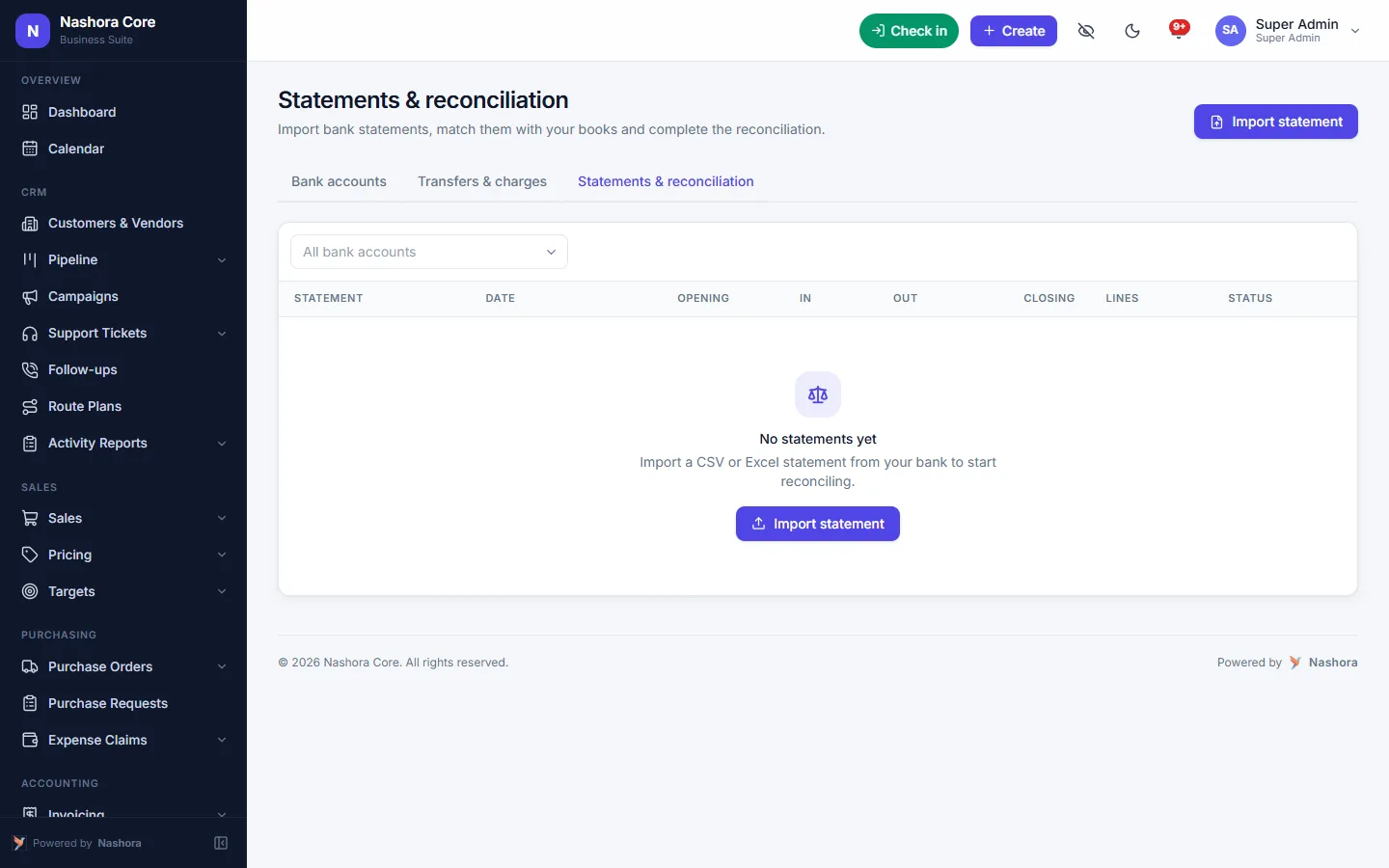
- Reconcile the bank. Import the statement, match each line, and investigate what is left.
- Review the cheque register. What was deposited, what cleared, what falls due next month, both received and issued.
- Run the receivables aging. Pick the five biggest overdue accounts and assign a follow-up with a date to each.
- Run the payables aging. Plan the next payment runs by due date and cash available.
- Reconcile key supplier statements. Explain differences, book missing invoices, chase unrecorded payments.
- Check credit notes, doubtful debts and foreign balances. Revalue open foreign currency balances, then check the VAT return and lock the period after you file.
The bank step deserves its own mention, because every other number depends on it. The screen below is the statements and reconciliation page, where you import a statement from your bank and match it against receipts and payments.
Common mistakes with receivables and payables
- Invoicing late. The due date moves with the invoice date, so every day of delay costs a day of cash.
- Leaving receipts unallocated. The aging report overstates what customers owe and the follow-up goes to the wrong people.
- Keeping bills in an inbox. Unrecorded bills understate costs and VAT input, and the month looks better than it was.
- Treating a PDC as cash. Count it when it clears, not when you receive it.
- Chasing only the loud customers. The aging report decides who gets a call, not who shouts.
- Paying by memory. A payment run that follows due dates and approvals avoids duplicate payments and urgent phone calls.
- Using different definitions each month. DSO calculated differently every quarter is not a trend.
How Nashora handles receivables and payables
These are the parts of the process the system covers today, taken from our public feature list, so you can compare them with what you do now.
| Task | In Nashora | Notes |
|---|---|---|
| Customer invoices | Tax invoices with UAE VAT on every line | Standard, zero-rated, exempt or reverse charge; posts to the books |
| Receipts | Recorded against the invoice | Clears the receivable and appears in the bank reconciliation |
| Credit and debit notes | Customer credit notes and vendor debit notes | Posted documents are locked; corrections use credit notes or reversals |
| Follow-ups on overdue accounts | Follow-ups, activities and a shared calendar in the CRM | CRM is in the Business plan |
| Receivable and payable aging | Aging reports and a cash-flow view | Export to Excel and PDF |
| Vendor bills | Bills with VAT treatment per line | Approval rules by amount for bills and payments |
| Three-way match | Purchase order, goods received note and bill | Purchasing is in the Business plan |
| Payments | Vendor payments, with approval rules | Roles set who can create, approve or export |
| Cheques and PDC | Cheque register, post-dated cheques included | Due-date reminders before cheques fall due |
| Bank reconciliation | Statement import and matching | Match lines to receipts, payments and other entries |
| Foreign currency | Documents in any currency, month-end revaluation | Exchange gains and losses are posted |
| Month-end controls | Fiscal periods, period lock and an audit log | Lock a period after the VAT return is filed |
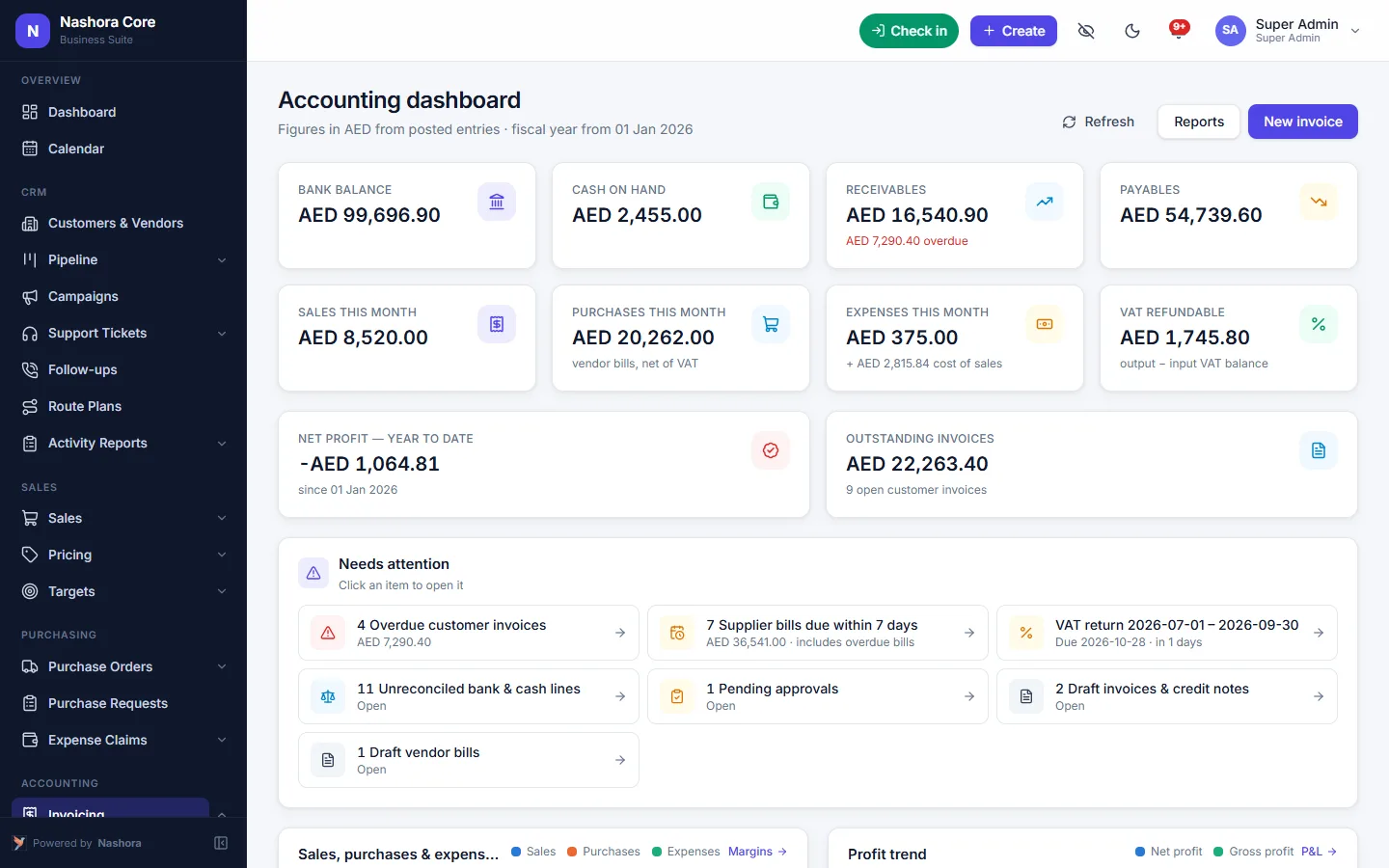
The accounting dashboard pulls the day-to-day signals together. The screenshot below shows the dashboard with sample data: receivables with the overdue portion in red, payables, and a "needs attention" panel listing overdue customer invoices, supplier bills due within 7 days, a VAT return that is due soon and unreconciled bank lines. Each tile opens the list behind it.
Because the customer invoice, the receipt and the follow-up live in the same system, chasing an overdue invoice is a task on the shared calendar, not a WhatsApp message that gets buried. More detail is on the accounting and VAT software page, and the CRM, sales and inventory page covers the sales side that feeds receivables.
A straight word on what is not on our feature list. We do not describe automated reminder letters to customers, a customer statement layout or automatic handling of early-payment discount terms. If your process depends on one of them, ask us to show it with your own example in a demo, and judge it on what you see.
Serving UAE businesses with receivables and payables
Receivables and payables in the UAE have local habits. Post-dated cheques are common on both sides, credit terms of 30 to 90 days are normal in trading, and a customer in Dubai may pay differently from one in Ras Al Khaimah. The principles are the same across Dubai, Sharjah, Abu Dhabi, Ajman, Ras Al Khaimah, Fujairah, Umm Al Quwain and Al Ain. We are based in Al Nahda, Sharjah, and Nashora runs in the browser for businesses in all of them.
VAT adds timing pressure. Output VAT on a credit sale is generally due in the return covering the invoice or supply date, whether or not the customer has paid, and a VAT 201 return is due 28 days after the period ends. That means slow collection costs you tax cash as well as sales cash, which is a good reason to invoice correctly the first time. For a business with several outlets, the multi-branch guide shows how to read results branch by branch, and the guide on purchase orders and supplier payments goes deeper on the buying side. Corporate tax at 9% makes accurate receivables and bad debt records worth keeping for your adviser. Free zone and mainland companies are treated differently for tax, so confirm your own position.
What to do next
- Run an aging report today. If you do not have one, sort open invoices by due date in a spreadsheet and create the buckets above.
- Calculate your DSO and DPO. Use the formulas in this guide and write the result down, so you can compare next quarter.
- Write your credit terms. One page: terms by customer type, who approves credit, when a reminder goes out and when you escalate.
- Set a payment-run rhythm. Pick days of the week, an approval rule by amount and a person who reconciles supplier statements.
- See it in one system. Book a free accounting demo, bring your aging lists and a bank statement, and we will walk through invoices, receipts, bills and reconciliation. The pricing page and the FAQ cover plans and setup, or talk to us directly.